Got a 0, 1 or 2 food hygiene rating? A 30-day plan
A low rating is hard to read about your own business. It records how well the business met food safety standards when it was last inspected, and government guidance says it is not a guide to food quality. Here is a calm plan for the next 30 days.
The plan follows the scheme in England, Wales and Northern Ireland, using English guidance unless a nation is named. The scoring comes from English sources; Welsh and Northern Irish scoring documents were not checked. Scotland comes at the end.
The 30 days at a glance
Days 1 to 3
Read the letter and note the dates
- Read the officer’s letter or report all the way through.
- Write down when you were notified of your rating (the date on the letter, or the day you were told). Any appeal is due within 21 days of receiving that notification. If you are unsure which date counts, ask your council straight away.
Rest of week 1
List every point and start on the first
- List each point from the report with its deadline, earliest first.
- Each time you put something right, write down what you did and the date.
- Decide whether to appeal or send a reply (see below).
Weeks 2 and 3
Fix, train and keep records going
- Work through the rest of the list.
- Check everyone who handles food is supervised and instructed or trained for their work, and note it.
- If a process or step has changed, review your written procedures.
- Keep daily checks written down, such as fridge temperatures and cleaning.
Week 4
Check the list and decide on a re-rating visit
- Check each point on your list against the letter.
- When the improvements are made, you can ask for a re-rating visit (rules below).
- Keep the records going after day 30.
Day 1 is the day you start this plan; the 21-day appeal period may already be running. If the letter gives a deadline sooner than this plan, the letter wins.
Start with the letter
You are told your rating, and the reasons, in writing at the inspection or within 14 days. Government guidance says that after a low rating, the letter confirms the improvements needed and the deadlines. The sources checked for this page do not set out what follows a particular rating, so follow the letter.
Write down each fix and its date: government guidance says a food safety management system must keep records of how problems were put right.
Your safeguards, exactly
- Appeal. Under guidance in England and the law in Wales and Northern Ireland, you can appeal in writing within 21 days of receiving notification of your rating. Weekends and bank holidays count. The council decides within 21 days, and the officer who gave the rating does not review it. In Northern Ireland the only valid ground is that the rating does not reflect hygiene standards at the time of the inspection.
- When it is published. Government guidance says ratings of 0 to 4 are published 3 to 5 weeks after the inspection, to allow time for an appeal. A rating under appeal shows as “awaiting publication”.
- Right to reply. You can send a written reply at any time. It is published online with your rating, until you get a new rating. Keep it factual: the council may edit remarks that are offensive, defamatory, clearly inaccurate or irrelevant.
- Re-rating visit in England. Government guidance says you can ask once you have accepted the rating and made the improvements the officer recommended. There is usually no visit in the first three months after the rating, unless only structural or equipment work was needed. Requests in that window are normally visited within six months, later ones within three. Without a fee, one visit is allowed between planned inspections.
- Re-rating in Wales and Northern Ireland. In Wales, the council must inspect within three months of your request once the conditions are met, such as any appeal being decided and the current sticker being displayed. In Northern Ireland, you can ask once the appeal period has ended or an appeal is decided; the council then has three months to inspect and review the rating, or to explain in writing why not.
- Fees. Some councils in England charge for a re-rating visit; all councils in Wales and Northern Ireland do. One dated example: Bath and North East Somerset’s policy (updated April 2026) gives £208, checked on 22 November 2026. Check your own council’s page.
How a low rating is reached
The officer scores three areas: food handling, the physical condition of the business, and food safety management (“confidence in management” in the English code of practice). A lower score is better, and the scores are added up.
Three English councils (Derby, Cheltenham, Bath and North East Somerset) publish the same table: a total and a highest single score for each rating. They do not print the rating beside each row, so rows are matched by order; the Food Standards Agency’s own table could not be read. Our guide to a 5 shows it in full.
Why one high score holds the rating below 3. Under that table, the rows for 2, 1 and 0 start at a total of 35. Three scores of 10 or less add up to 30 at most, so at least one area scored 15 or more. The rows for 3, 4 and 5 allow no single score above 10, so while any area stays at 15 or more, the table gives no rating of 3 or above.
Where procedures, training and records fit
The English officers’ practice guidance links a good management score with staff trained in HACCP principles and records suited to the business, and poor scores with missing procedures and staff not suitably supervised, instructed or trained.
Under the council table, a score of 15 or more in any one area rules out a 3 or above. So records help, but on their own they cannot lift the rating past a high score elsewhere.
If paperwork was part of it
If the report mentions missing records, these free blank templates print on A4 and are filled in by hand. They are record templates, not a food safety management system or a HACCP plan.
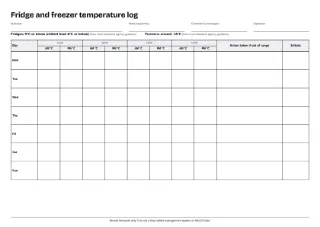
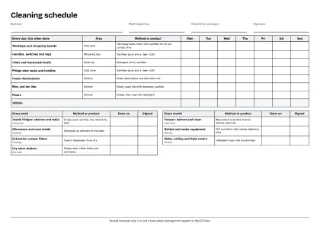
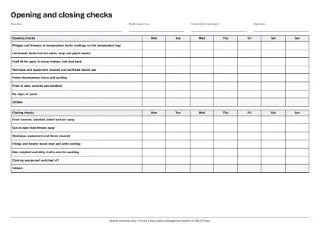
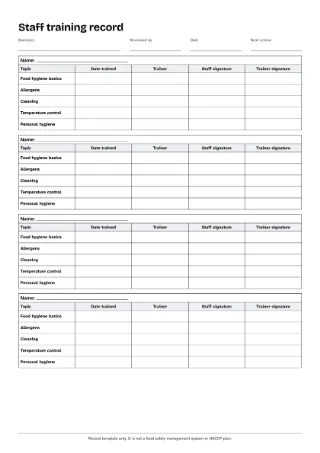
If allergen information came up, the tool lays out an allergen matrix from your menu. Free to build and check on screen. Pay once to print. Neither the templates nor the tool can promise a better rating.
Wales, Northern Ireland and Scotland
In Wales, displaying your rating sticker is a legal requirement once the appeal period ends or an appeal is decided. In Northern Ireland, display is a legal requirement too, and you must give your rating if asked in person or by phone.
Scotland’s Food Hygiene Information Scheme has no 0 to 5 score. Improvement Required means the business did not broadly meet legal requirements at its latest inspection. A business can ask for a re-visit after improving. This guide could not confirm Scotland’s appeal or reply arrangements: check with your council.
Sources
Last checked: 22 November 2026. The Food Standards Agency’s own pages on food.gov.uk could not be read when this guide was checked. The facts here come from GOV.UK, which publishes the Agency’s guidance, from legislation.gov.uk, from council documents, and, for Scotland, from Food Standards Scotland. How each fact was checked is on the sources page.
- Food hygiene rating scheme: guidance for businesses (GOV.UK, updated 30 June 2026)
- Food hygiene ratings (GOV.UK, 25 June 2026)
- Food safety inspections (GOV.UK, updated 30 January 2025)
- Food Law Code of Practice (England), Annex 1
- Food Law Practice Guidance (England), 25 June 2026, Annex 3
- Derby City Council: food rating scoring explained (April 2018)
- Cheltenham Borough Council: how your food hygiene rating is calculated
- Bath and North East Somerset Council: FHRS policy (April 2026)
- Regulation (EC) No 852/2004, Annex II, Chapter XII: training (legislation.gov.uk)
- Food safety management systems (GOV.UK, 9 September 2026)
- Food Hygiene Rating (Wales) Act 2013, sections 5, 7 and 12
- Food Hygiene Rating Act (Northern Ireland) 2016, sections 3, 4 and 7
- Food Hygiene Information Scheme (Food Standards Scotland)
- Food Hygiene Information Scheme: business guidance (Food Standards Scotland)